
Termite Extermination in St. Pete
Tell drywood frass apart from Eastern and Formosan subterranean swarmers, compare tenting vs. localized treatment, and understand Florida WDO warranties.
Read Termite Guide →Looking for a St. Pete exterminator? Start by identifying the exact Florida pest you are dealing with, checking whether treatment requires a licensed specialist or a free local city/county program, and knowing realistic St. Petersburg treatment costs before you get quotes.
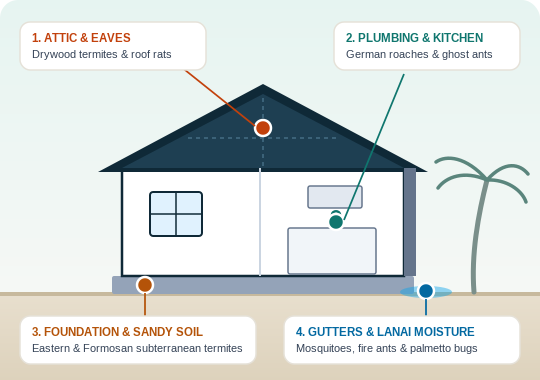
Select what you are seeing around your St. Petersburg home to get a plain-English Florida species match, immediate safe steps, the exact Florida license category to verify, and the right local guide.
Coastal Pinellas humidity, sandy soil, and warm winters create year-round pest activity across the Tampa–St. Pete area. Here is how the six main local pests compare.
| Pest Type | Peak St. Pete Season | Key Warning Signs | Primary Exterminator Method | FDACS License |
|---|---|---|---|---|
| Drywood & Subterranean Termites | Feb–May (Eastern); Apr–Jul (Formosan & Drywood) | Equal-length wings, 6-sided wood pellets (frass), mud tubes on foundation | Liquid soil barrier / bait stations (subterranean); spot injection or tenting (drywood) | WDO (+ Fumigation for tenting) |
| Palmetto Bugs & German Roaches | Year-round; spikes after summer rainstorms | Large reddish-brown intruders outdoors/inside, or small striped roaches in kitchens | Exterior exclusion + perimeter barrier (palmetto); gel bait + IGR clean-out (German) | GHP |
| Ghost, Fire & Big-Headed Ants | Year-round; heavy spring–fall foraging | Tiny pale-legged counter trails, sand piles in pavers, stinging lawn mounds | Non-repellent baits (never harsh contact sprays on indoor ghost ants) | GHP (indoor) / L&O (turf) |
| Roof Rats & Attic Rodents | Year-round; spikes during fall cool fronts & fruiting seasons | Night attic scratching, rub marks on soffits, gnawed citrus/avocados | Interior trapping + galvanized exclusion sealing (plus free St. Pete outdoor program) | GHP |
| Mosquitoes | May–November wet season | Biting around shaded patios, bromeliads, clogged gutters, and standing water | Source reduction + larvicides + shaded foliage barrier (plus Pinellas County IPM) | GHP / Public Health |
| Bed Bugs | Year-round (travel & multi-unit turnover) | Clustered overnight bites, dark specks on mattress seams, shed skins | Structural heat remediation and/or multi-visit residual + desiccant dust | GHP or Fumigation |
Each guide focuses on the species, housing construction, and municipal rules specific to St. Petersburg and Pinellas County.
Tell drywood frass apart from Eastern and Formosan subterranean swarmers, compare tenting vs. localized treatment, and understand Florida WDO warranties.
Read Termite Guide →Why large Florida palmetto bugs need moisture and gap sealing while small German roaches require non-repellent gel baits and insect growth regulators.
Read Roach Guide →How to stop ghost ants from splitting into new colonies in your walls, plus practical Pinellas control for fire ants, big-headed ants, and carpenter ants.
Read Ant Guide →How roof rats enter older St. Petersburg eaves, why sealing beats poison alone, and what the City of St. Petersburg Sanitation program covers for free outdoors.
Read Rodent Guide →Using Pinellas County Mosquito Control alongside yard prevention, plus how to verify bed bug signs and compare heat vs. multi-visit chemical remediation.
Read Mosquito & Bed Bug Guide →Calculate realistic St. Petersburg treatment price ranges by pest type, home square footage, and foundation style—plus exact questions to ask on quotes.
Open Cost Estimator →Florida regulates structural pest control under Florida Statutes Chapter 482 through the Florida Department of Agriculture and Consumer Services (FDACS). Run through these four checks before signing any contract:
Sitting on the Pinellas peninsula between Tampa Bay and the Gulf of Mexico, St. Pete combines warm coastal humidity, sandy soil, mature oak and palm canopies, and a large stock of 1920s–1970s block and wood-frame bungalows.
Older historic districts like Old Northeast, Historic Kenwood, and Snell Isle often deal with drywood termite exposure in original wood framing and roof rats using mature tree canopies to reach attics. Waterfront and low-lying neighborhoods like Shore Acres, Riviera Bay, and St. Pete Beach see heavier subterranean termite moisture pressure and post-rain palmetto bug movement. See our St. Petersburg & Pinellas County Neighborhood Guide for area-by-area patterns across the Tampa–St. Pete bay area.
The most frequent calls in St. Petersburg and Pinellas County involve drywood and subterranean termites (including Formosan termites), palmetto bugs and German cockroaches, ghost ants and fire ants, roof rats in attics, seasonal mosquitoes, and bed bugs.
Search the business name or certified operator on the public FDACS Licensing Portal under Chapter 482. Confirm their license status is active and covers the exact category needed (GHP, WDO, or Fumigation).
Yes, for outdoor rodents only. St. Petersburg's Sanitation Department inspects residential exteriors and places tamper-resistant outdoor bait stations at no charge. They do not treat inside homes—indoor rodents and all insects require a licensed private exterminator. Pinellas County also runs countywide mosquito surveillance and treatment.
Per UF/IFAS guidance, Eastern subterranean termites swarm mainly February through May during warm daytime hours after rain; Formosan subterranean termites swarm March through July at dusk/night around lights; and drywood termites peak April through July during evening hours, though sporadic swarms can appear into fall.
Typical planning ranges run $110–$185 for an initial general pest treatment ($95–$145 quarterly), $450–$1,450 for roof rat trapping and exclusion, $1,100–$2,600 for subterranean termite perimeter systems, and $1,600–$3,200+ for whole-structure drywood tenting. Use our St. Pete Cost Estimator to tailor ranges to your home size.